+Giotto must have had assistance in laying out the surface and in the actual painting.
+Giotto used a short cut by using paper and parchment to transfer drawing on the fresco.
+Giotto portrays emotions on the subjects on his fresco paintings.
+Some of the images are distroyed by white wash.
+Bardi Chapel contains freco paintings of St Francis's life.
+ Bardi Chapel is a religion order church of St Frances.
mari
Sunday, May 8, 2011

Ch.1 Sculpture
+Sculptures were abundant= decoration
+Ancient sculptures provided inspiration
+Greek and Roman sculpture adopted during the Renaissance/ realism was being about with sculpture
+Sculptres were included among the Liberal Arts. Sculpting was called "stone cutting"
+When creating stone sculptures, the artist probably drew the 4 profile drawings of the image they wanted to carve on the block before carving
+The stone sculpture created in Italy was mostly made from marbles. They are created and placed near the Mt. near Carrara or Piza where the stones were found, because moving stones were difficult.
mari
+Ancient sculptures provided inspiration
+Greek and Roman sculpture adopted during the Renaissance/ realism was being about with sculpture
+Sculptres were included among the Liberal Arts. Sculpting was called "stone cutting"
+When creating stone sculptures, the artist probably drew the 4 profile drawings of the image they wanted to carve on the block before carving
+The stone sculpture created in Italy was mostly made from marbles. They are created and placed near the Mt. near Carrara or Piza where the stones were found, because moving stones were difficult.
mari
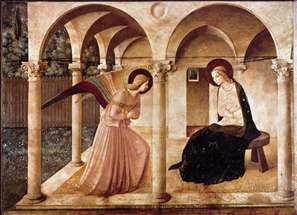
ANNUNCIATION (2) - Fra Angelico
Monastery of S. Marco, Florence
Commissioned by Medici
“As you venerate this figure of the intact Virgin while passing before it, beware lest you omit to say a Hail Mary”
Date uncertain
Rituals of monastic life seen
 Hallway

Monk's Cell
Fra Angelico’s interest in natural light is evident - situated in a location where light floods in
The bright colors and gold of the Annunciation altarpiece are replaced by pale tints - appropriate for monks
Everything about these pieces is clean and simple
Only window to the world is the one behind the Virgin
St. Antoninus warns against letting sin in through the ‘window of your soul’ - eyes
Angel is kneeling and virgin sitting
Angel kneeling and Virgin standing
Significance? Shows different aspect of Virgin
Virgin is slight and frail
Different approaches at interpreting the Annunciation
Angel has entered with the light, which falls on the virgin
Unified by the arched hallways and arches
St. Peter meditates on the event
Plain colors, simplified shapes suggests that no worldly concerns should trouble the spirit
The observer is the center
Perspective system is developing with perspective points
Commissioned by Medici
“As you venerate this figure of the intact Virgin while passing before it, beware lest you omit to say a Hail Mary”
Date uncertain
Rituals of monastic life seen

Monk's Cell
Fra Angelico’s interest in natural light is evident - situated in a location where light floods in
The bright colors and gold of the Annunciation altarpiece are replaced by pale tints - appropriate for monks
Everything about these pieces is clean and simple
Only window to the world is the one behind the Virgin
St. Antoninus warns against letting sin in through the ‘window of your soul’ - eyes
Angel is kneeling and virgin sitting
Angel kneeling and Virgin standing
Significance? Shows different aspect of Virgin
Virgin is slight and frail
Different approaches at interpreting the Annunciation
Angel has entered with the light, which falls on the virgin
Unified by the arched hallways and arches
St. Peter meditates on the event
Plain colors, simplified shapes suggests that no worldly concerns should trouble the spirit
The observer is the center
Perspective system is developing with perspective points
BRUNELLESCHI - Ospedale degli Innocenti “Hospital of the Innocents”
Ospedale degli Innocenti
“Hospital of the Innocents”
-Built in 1420
-Provided orphans and abandoned children housing, education, and vocational training until they reached the age of 18
-Children were given the last name “Innocenti”
-Kept ancient architectural details in his buildings, however, his frequent use of arches supported on columns showed his style and could not be mistaken with the ancient buildings
-Brunellschi interested in measure and proportion creates his well-known harmony
-Provided builders with a measured scale drawing - something they had never seen before
-His system of proportions is based on the 6th century BC writings of Pythagoras
-His rationally planned buildings is influenced but different from that of ancient Roman structures - more mathematically balanced
This was the culmination of his style.
Brunellschi was a genius and made his buildings his own despite the various influences
The arches on the columns, the mathematical system of his architectural pieces
Building an orphanage type of building surprised me - commissioned
Most famous designer in Italy

“Hospital of the Innocents”
-Built in 1420
-Provided orphans and abandoned children housing, education, and vocational training until they reached the age of 18
-Children were given the last name “Innocenti”
-Kept ancient architectural details in his buildings, however, his frequent use of arches supported on columns showed his style and could not be mistaken with the ancient buildings
-Brunellschi interested in measure and proportion creates his well-known harmony
-Provided builders with a measured scale drawing - something they had never seen before
-His system of proportions is based on the 6th century BC writings of Pythagoras
-His rationally planned buildings is influenced but different from that of ancient Roman structures - more mathematically balanced
This was the culmination of his style.
Brunellschi was a genius and made his buildings his own despite the various influences
The arches on the columns, the mathematical system of his architectural pieces
Building an orphanage type of building surprised me - commissioned
Most famous designer in Italy
ANDREA DA FIRENZE - Triumph of the Church
Andrea da Firenze - Triumph of the Church
Real name is Andrea Bonaiuti
Little of his work now survives
He does have a panoramic series of frescoes in the Chapter House at Santa Maria Novella, where the monks met regularly to discuss issues of governance
Massive panoramics
Theme is ecclesiastical rather than secular government - emphasized the role of authority the Dominican Order had
Triumph of the Church or “Road to Salvation” was the most “unusual”
The lower part is concerned with religious life on earth and the upper part with heaven - area between is controlled by the Dominican Order

Having this piece commissioned by the Dominican Order showed the importance of the voice art and architecture had in society
Political groups made statements by using art in ways to voice their stands, beliefs and power
Real name is Andrea Bonaiuti
Little of his work now survives
He does have a panoramic series of frescoes in the Chapter House at Santa Maria Novella, where the monks met regularly to discuss issues of governance
Massive panoramics
Theme is ecclesiastical rather than secular government - emphasized the role of authority the Dominican Order had
Triumph of the Church or “Road to Salvation” was the most “unusual”
The lower part is concerned with religious life on earth and the upper part with heaven - area between is controlled by the Dominican Order
Having this piece commissioned by the Dominican Order showed the importance of the voice art and architecture had in society
Political groups made statements by using art in ways to voice their stands, beliefs and power
Crucifix - Giotto Mainly
Crucifixes
Explain:
Crucifixes started with the School of Pisa where the purpose of the crucifix was to present an image of a powerful deity who could overcome the torment of the Crucifixion (Christ triumphant) - eventually showed the suffering Chris
Crucifix usually displayed the high emotional content of their painters - i.e. Coppo di Marcovaldo relfects his wartime experiences
Cimabue - big Byzantine influence in his Crucifix (destroyed by flood in 1966)
Giotto's SM Novella Crucifix drew an intense empathetic response from the viewer
Giotto banished the Byzantine manner and revived the modern and good art of painting, introducing the portraying well from nature of living people, which had not been used to more than two hundred years
Giotto's Crucifix was similar to that of Cimabue's
Same background, frame, and people on the sides of the cross, but Giotto brought back the 3-dimensionality of the human form. Christ hangs in space - very physical and very human
Model:
Instead of the common human form that is very 2-dimensional that all artists had been using for the crucifixes.. Giotto redefines human physicalities in paintings - and brings back the natural form that used to be painted of humans.
Analyze:
Giotto banished the Byzantine manner and revived the modern and good art of painting, introducing the portraying well from nature of living people, which had not been used to more than two hundred years - influenced the art form of that era
-Kelsey Masuda
Explain:
Crucifixes started with the School of Pisa where the purpose of the crucifix was to present an image of a powerful deity who could overcome the torment of the Crucifixion (Christ triumphant) - eventually showed the suffering Chris
Crucifix usually displayed the high emotional content of their painters - i.e. Coppo di Marcovaldo relfects his wartime experiences
Cimabue - big Byzantine influence in his Crucifix (destroyed by flood in 1966)
Giotto's SM Novella Crucifix drew an intense empathetic response from the viewer
Giotto banished the Byzantine manner and revived the modern and good art of painting, introducing the portraying well from nature of living people, which had not been used to more than two hundred years
Giotto's Crucifix was similar to that of Cimabue's
Same background, frame, and people on the sides of the cross, but Giotto brought back the 3-dimensionality of the human form. Christ hangs in space - very physical and very human
Model:
Instead of the common human form that is very 2-dimensional that all artists had been using for the crucifixes.. Giotto redefines human physicalities in paintings - and brings back the natural form that used to be painted of humans.
Analyze:
Giotto banished the Byzantine manner and revived the modern and good art of painting, introducing the portraying well from nature of living people, which had not been used to more than two hundred years - influenced the art form of that era
-Kelsey Masuda
TEMPERA
Tempera
Explain:
-Fresco and Tempera were the main techniques used in the 13th century.
-First step to design is to construct the wooden panels of finely sanded poplar, linden, or willow wood
-Second step is to cover the panels and the wood with A LOT of gesso
-Third step is to sketch out with charcoal the design and drawing
-A gold layer is always added behind the figures in paintings in that age (gold leaf)
-Then the underpainting which then comes the final layers of tempera to finish the layers of the process
Based on Cennini
-Detailed descriptions of the way Cennini did things/painted
-There weren't any other 'technical handbooks' on technique during that era other than Cennini's
-He tried and figured out ways in painting that would last
Shaped the way painting was done to preserve paintings
i.e. Madonna and Child done by Duccio di Buoninsegna lasted a very long time because of this method
Created a very "golden feel" to this tempera method - influenced the look in that time
Explain:
-Fresco and Tempera were the main techniques used in the 13th century.
-First step to design is to construct the wooden panels of finely sanded poplar, linden, or willow wood
-Second step is to cover the panels and the wood with A LOT of gesso
-Third step is to sketch out with charcoal the design and drawing
-A gold layer is always added behind the figures in paintings in that age (gold leaf)
-Then the underpainting which then comes the final layers of tempera to finish the layers of the process
Based on Cennini
-Detailed descriptions of the way Cennini did things/painted
-There weren't any other 'technical handbooks' on technique during that era other than Cennini's
-He tried and figured out ways in painting that would last
Shaped the way painting was done to preserve paintings
i.e. Madonna and Child done by Duccio di Buoninsegna lasted a very long time because of this method
Created a very "golden feel" to this tempera method - influenced the look in that time
Subscribe to:
Posts (Atom)